


TYPE N Socket Series (Brazilian Socket)
The TYPE N socket is a standard promoted by the International Electrotechnical Commission (IEC) and established by the Brazilian National Standards Organization (ABNT). It was designed to replace Brazil’s previously inconsistent use of various plug and socket types, aiming to create a unified electrical connection system. The standard code is NBR 14136, and it is widely applied in residential, commercial, and industrial environments across Brazil.
The TYPE N socket closely resembles the Swiss TYPE J in appearance, with three round holes arranged in a straight line. However, they differ completely in dimensions, spacing, current capacity, and national standards, and are not interchangeable.
Rated Voltage: 127V, 220V
Rated Current: 10A, 20A
Grounding: Equipped with grounding terminal
Compatible Plug: TYPE N plug
Common Regions: Brazil (fully implemented after 2001)
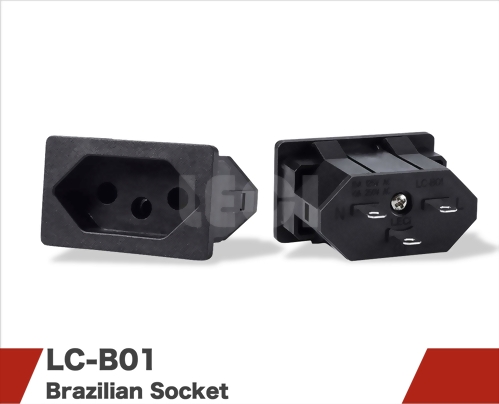
LC-B01
Insulation Resistance: ≥ 100MΩ 500V DC
Contact Resistance: ≤ 50mΩ
Dielectric Strength:
Between Terminals: 2500VAC (50-60Hz) 1 min
Terminals to Plastic: 3750VAC (50-60Hz) 1 min
Insertion and withdrawal force: 1.36kgf~6.8kgf
Operating Temperature: -10 ℃ ~ 105℃
Solderability: 230±10℃ 3±1Sec.
Solder Heat Resistance:
255±5℃ for 3±1 sec (wave soldering)
350±10℃ for 3±0.5 sec (manual soldering)
Cold Resistance: -20±2℃ for 96h
Humidity Resistance: 40±2℃ 90-95%RH for 96h
Heat Endurance: 105±2℃
Mechanical Life: 6,000 cycles